Transforming Cloud Reliability: AWS Resilience Hub Introduces Automated Fault Injection and Pre-Configured Testing

The modern enterprise cloud architecture is a marvel of distributed complexity, yet this intricate web of microservices, multi-region databases, and interconnected APIs introduces unprecedented vulnerability to unexpected disruptions. Organizations have long understood that defining resilience policies and assessing application health are merely preliminary steps in a rigorous reliability lifecycle. The ultimate test has always been verifying whether these distributed systems actually behave as expected when critical infrastructure inevitably fails. Historically, designing fault injection experiments manually has demanded deep engineering expertise, requiring teams to painstakingly determine which faults to inject, which specific resources to target, and how to objectively judge whether an outcome constitutes success.
For many engineering departments, this high barrier to entry meant experiments were either delayed indefinitely or built entirely by hand, only to drift out of date as architectures continually evolved. Addressing this operational bottleneck, Amazon Web Services has rolled out a next-generation capability within AWS Resilience Hub. Powered by AWS Fault Injection Service (FIS), the platform now introduces recommended resilience testing, an out-of-the-box validation framework designed to automatically test how cloud services respond to and recover from severe failure scenarios without requiring teams to write custom testing scripts from scratch.
The Evolution of Cloud Resilience and Automated Experimentation
To understand the significance of this development, one must examine the historical trajectory of cloud reliability engineering. In the early days of cloud computing, disaster recovery was often treated as a periodic checklist exercise—a theoretical blueprint tested perhaps once a year during scheduled maintenance windows. As architectures shifted from monolithic applications to microservices distributed across multiple Availability Zones (AZs) and global regions, these periodic manual reviews became entirely inadequate.
Chaos engineering emerged as a disciplined approach to building confidence in a system’s capability to withstand turbulent conditions in production. However, early iterations of chaos engineering tools required significant overhead. Engineers had to manually orchestrate scripts, manage permissions, and meticulously construct monitoring dashboards to catch anomalies. This manual approach frequently introduced human error or left critical edge cases untested, particularly as development velocity outpaced infrastructure governance.
Recognizing these industry-wide pain points, AWS Resilience Hub now leverages its existing contextual knowledge of an application’s ecosystem—including its underlying cloud resources, complex dependency maps, and defined resilience policies—to automate the heavy lifting. Instead of forcing developers to guess which failure modes to prioritize, the platform automatically translates architectural metadata into executable FIS experiments. It injects faults, monitors live telemetry, and evaluates outcomes against predefined success criteria and recovery time objectives (RTO), rendering a definitive pass or fail grade accompanied by an auto-generated compliance report accessible directly through the Resilience Hub console.
Core Testing Framework: Four Pillars of Failure Validation
Out of the box, the next-generation Resilience Hub provides four distinct, pre-configured tests tailored to a service’s specific architecture and resilience policy. These tests are structured around three operational levels: test templates (the pre-configured recommendations specifying fault actions and target parameters), configured tests (customized instances featuring specific success alarms and stop conditions), and test runs (single executions that evaluate current resources against established thresholds).
The first capability, Availability Zone recovery, validates a service’s capacity to detect and recover from a localized AZ impairment. By artificially injecting the symptoms of a power interruption or network partition within a single AZ—affecting compute, networking, storage, and database layers simultaneously—the test confirms whether the application successfully reroutes traffic to healthy zones and restores full operational capacity within the stated RTO. Beyond verifying recovery speed, this test frequently surfaces hidden single-AZ dependencies that engineering teams may have inadvertently introduced.
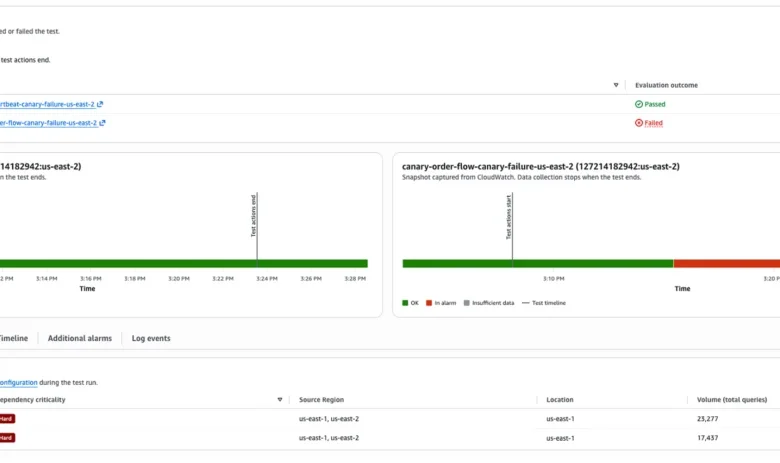
The second capability, dependency validation, addresses one of the most frequently requested features from enterprise cloud architects. Modern cloud applications routinely rely on dozens of internal and external services. Understanding which dependencies are truly mission-critical versus those that can fail gracefully is paramount. The dependency validation test blocks connectivity to selected regional dependencies using packet-loss mechanisms injected at the compute layer across Amazon Elastic Compute Cloud (EC2) instances, Amazon Elastic Container Service (ECS) tasks, and Amazon Elastic Kubernetes Service (EKS) pods. By systematically evaluating soft dependencies (such as analytics APIs or recommendation engines) against hard dependencies (such as primary authentication services or databases), teams gain empirical clarity on their application’s true fault-tolerance boundaries.
The third and fourth capabilities focus on multi-region isolation and recovery. The Multi-Region isolation test blocks connectivity between two distinct AWS Regions—including cross-region data replication and network traffic—to validate whether a service can continue operating independently during a regional isolation event. This serves as a vital precursor to the Multi-Region recovery test, which introduces deep failures into a primary region and verifies through success alarms that an application successfully recovers and serves clients within the defined RTO in a secondary recovery region after a failover action or Amazon Application Recovery Controller (ARC) switch plan is executed.
Methodological Rigor: Success Criteria and Decision Frameworks
A central innovation of the next-generation Resilience Hub is its emphasis on holistic service-health metrics over isolated infrastructure monitoring. Traditional testing often resulted in false alarms caused by examining individual component failures rather than overall customer experience. AWS Resilience Hub addresses this by tying test outcomes to high-level business indicators, such as order success rates or end-to-end transaction availability.
For recovery tests, success is achieved when all designated business metrics return to a healthy state within the policy-defined RTO and hold steady until the test concludes. For sustained tests—such as dependency validation and multi-region isolation—success requires that performance thresholds remain stable from the exact moment fault injection begins through the termination of the test. To ensure operational safety, Amazon CloudWatch alarms act as guardrails or stop conditions, automatically halting experiments if system degradation exceeds acceptable safety limits.
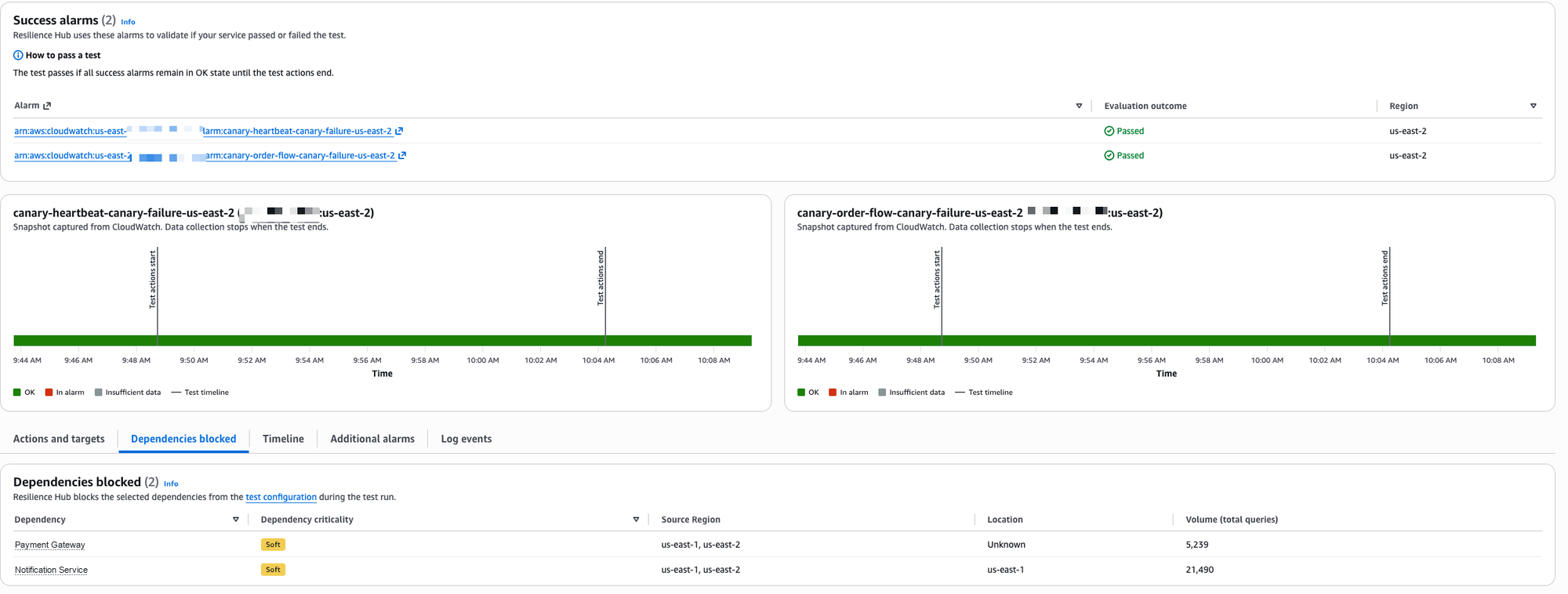
To help engineering organizations interpret these empirical results, AWS provides a comprehensive decision framework. When a soft dependency is blocked and the test passes, it confirms that graceful degradation mechanisms are functioning correctly. Conversely, if a soft dependency test fails, it reveals either a misclassification of the service tier or a hidden architectural flaw in the application’s error-handling logic. Similarly, validating hard dependencies ensures that critical failures are appropriately contained without triggering cascading system-wide collapses.
Industry Implications and Market Analysis
Industry analysts note that automated resilience testing represents a fundamental shift in how cloud governance and compliance are managed. As regulatory requirements for digital operational resilience—such as the Digital Operational Resilience Act (DORA) in Europe and evolving financial sector mandates globally—grow increasingly stringent, enterprises are under pressure to provide continuous, auditable proof of their system resilience. Manual testing logs and theoretical disaster recovery plans are no longer sufficient to satisfy modern audit standards.
By embedding evidence-backed validation directly into the deployment pipeline, AWS is bridging the longstanding gap between architecture design and operational reality. Organizations can now execute these tests on demand, monthly, or quarterly, embedding the resulting compliance reports directly into their broader governance frameworks. This capability transforms resilience from a static compliance hurdle into a dynamic, continuously verified operational metric.
Availability and Getting Started
Recommended resilience testing within the next generation of AWS Resilience Hub is generally available today across all commercial AWS regions where the service is supported. Engineering teams can initiate their resilience validation journey by accessing the testing tab within their service dashboard, configuring appropriate AWS Identity and Access Management (IAM) service roles, and beginning with foundational assessments like dependency validation before advancing to complex multi-region recovery scenarios. As cloud architectures continue to grow in scale and distributed complexity, automated tools of this caliber will likely become foundational components of enterprise software engineering, ensuring that systems not only promise high availability, but consistently prove it under fire.